How to Choose a 3D Visualization Studio: The 12-Point Checklist
Hiring a 3D visualization studio is a decision that directly affects how your project is perceived by clients, planning authorities, and buyers. A great studio makes your design look inevitable and desirable. A poor one can make even excellent architecture look cheap. Yet most architects and developers choose a studio based on a quick glance at a portfolio and the lowest quote, which is how disappointing results happen.
This guide gives you a practical 12-point checklist for evaluating visualization studios, the exact questions to ask before you commit, and the warning signs that should make you walk away. Use it for your next project and you will hire with confidence instead of hope.
1. Study the Portfolio Like a Detective
A portfolio is a studio's best argument, but only if you read it critically. Look for consistency across projects, not just one stunning hero image. Check whether their exterior renders handle context well: real-looking streets, believable landscaping, and natural skies. Look at interiors for material realism: does wood look like wood, does fabric have texture, does light fall naturally?
Ask yourself whether their style matches what you need. Some studios excel at bright, airy residential work but struggle with moody commercial towers. If their portfolio has nothing resembling your project type, that is a risk. Also check dates: a portfolio that has not been updated in two years may not reflect the team's current quality or staff.
2. Understand Their Process
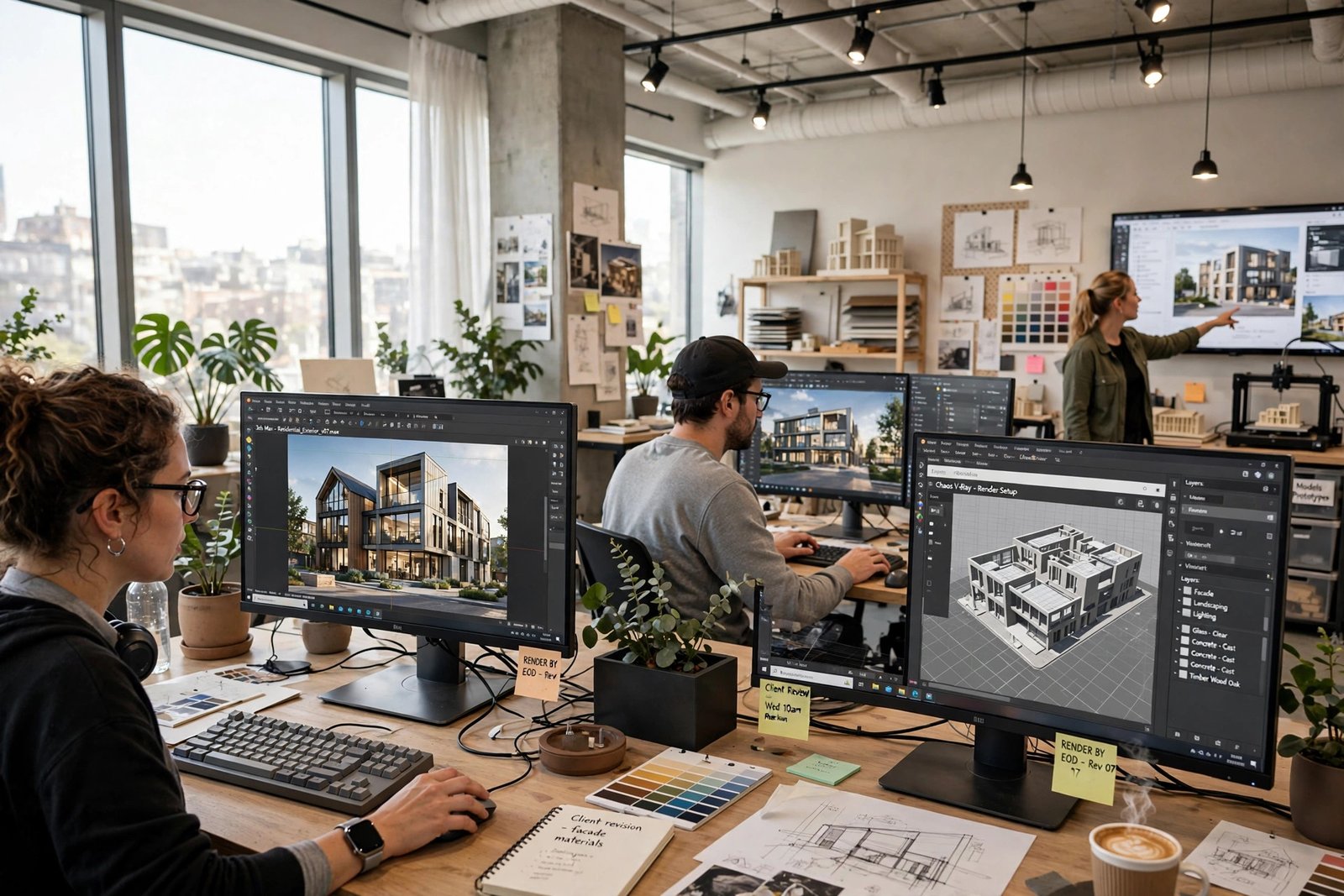
Professional studios run a defined production pipeline: briefing, 3D modeling, clay or draft renders for camera approval, materials and lighting, detailed drafts, revisions, and final delivery. If a studio cannot describe their process clearly, they probably do not have one, and your project will be managed by improvisation.
Pay special attention to the approval stages. You should get to approve camera angles before detailed work begins, because changing a camera late in production wastes days. A studio with a mature pipeline will show you exactly when you give input and what happens at each stage. Our own behind the scenes breakdown of a visualization studio pipeline shows what these stages look like in practice.
3. Evaluate Communication
Most visualization problems are communication problems. During your first exchanges, notice how quickly the studio responds, whether they ask smart questions about your project, and whether they confirm understanding in writing. A studio that asks about your target audience, the mood you want, and where the images will be used is thinking about your goals, not just pushing pixels.
Language and timezone matter for larger projects. You do not need the studio in your city, remote collaboration works well, but you do need overlapping working hours for feedback calls and a shared language for nuanced art direction.
4. Check the Revision Policy
Revisions are where budgets die. A clear revision policy states how many rounds are included, what counts as a revision versus a change of scope, and what extra rounds cost. Two to three included rounds is standard for still images. Be suspicious of unlimited revisions, which usually means the studio has no process for locking decisions, and be equally suspicious of zero included revisions.
Ask specifically about design changes. If your client changes the facade material halfway through, is that a revision or a new charge? The answer should be in writing before work starts.
5. Demand Pricing Transparency
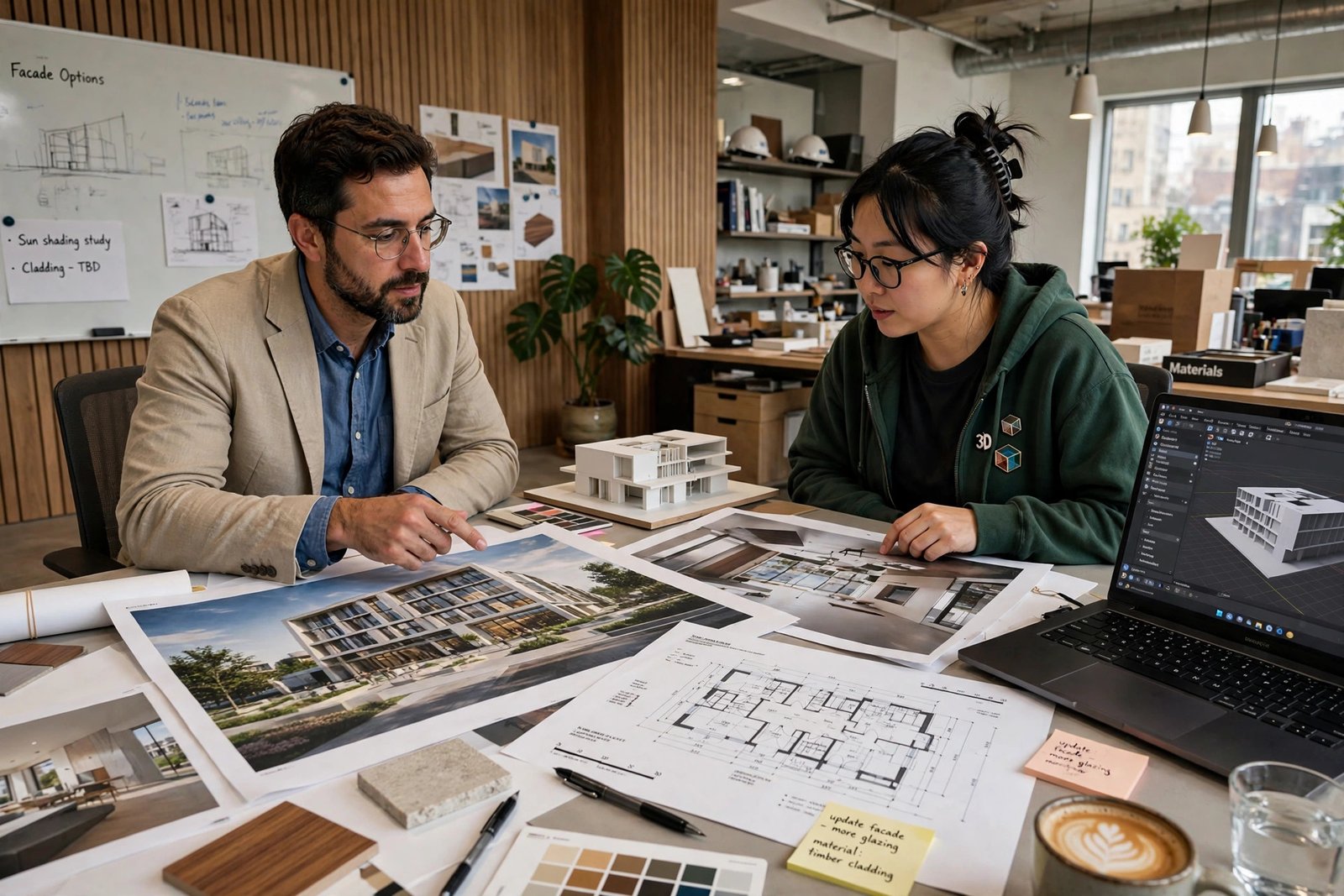
A trustworthy quote itemizes what you are paying for: number of views, modeling work, resolution, revision rounds, timeline, and usage rights. If a studio quotes a single lump sum with no breakdown, you cannot compare it fairly against competitors.
Also clarify payment terms. Fifty percent upfront with the balance on delivery is standard for new relationships. Full payment upfront is a red flag, and so is a price dramatically below market rate, which usually means corners will be cut somewhere you cannot see until delivery day.
6. Verify Turnaround Reliability
Ask for realistic timelines, not optimistic ones. A studio that promises a photorealistic exterior in 24 hours is either cutting quality or planning to miss the deadline. Standard turnarounds are five to ten working days per batch of still images and several weeks for animations. Ask what happens if they miss a deadline, and whether rush delivery is available at a defined surcharge.
For time-sensitive launches, consider the studio's capacity. A two-person team might do beautiful work but cannot absorb a ten-image rush order. Larger studios cost more but offer scheduling security.
7. Look at the Team, Not Just the Brand
Studios are people. Ask who will actually work on your project and look at their individual experience. A studio whose portfolio was built by senior artists who have since left may not deliver the same quality today. This is hard to verify directly, but asking about team size, roles, and who your day-to-day contact will be reveals a lot.
8. Confirm Technical Compatibility
Make sure the studio works with your file formats. If you design in Revit or ArchiCAD, confirm they can import your models cleanly. If you only have 2D drawings, confirm they can model from PDFs and DWGs, and ask what that modeling costs. Also confirm deliverable formats: print-resolution TIFFs or PNGs, web-optimized versions, and source files if your contract includes them.
9. Ask for References and Case Studies
Portfolios show finished images. Case studies show how the studio handles real projects: timelines, challenges, and client feedback. Ask for two or three references from clients with projects similar to yours, and actually contact them. Ask about communication, deadline reliability, and how revisions were handled. A studio confident in its service will provide references without hesitation. Detailed project stories, like this residential visualization case study or this resort visualization case study, show you how a studio thinks through a real brief.
10. Review the Contract Terms
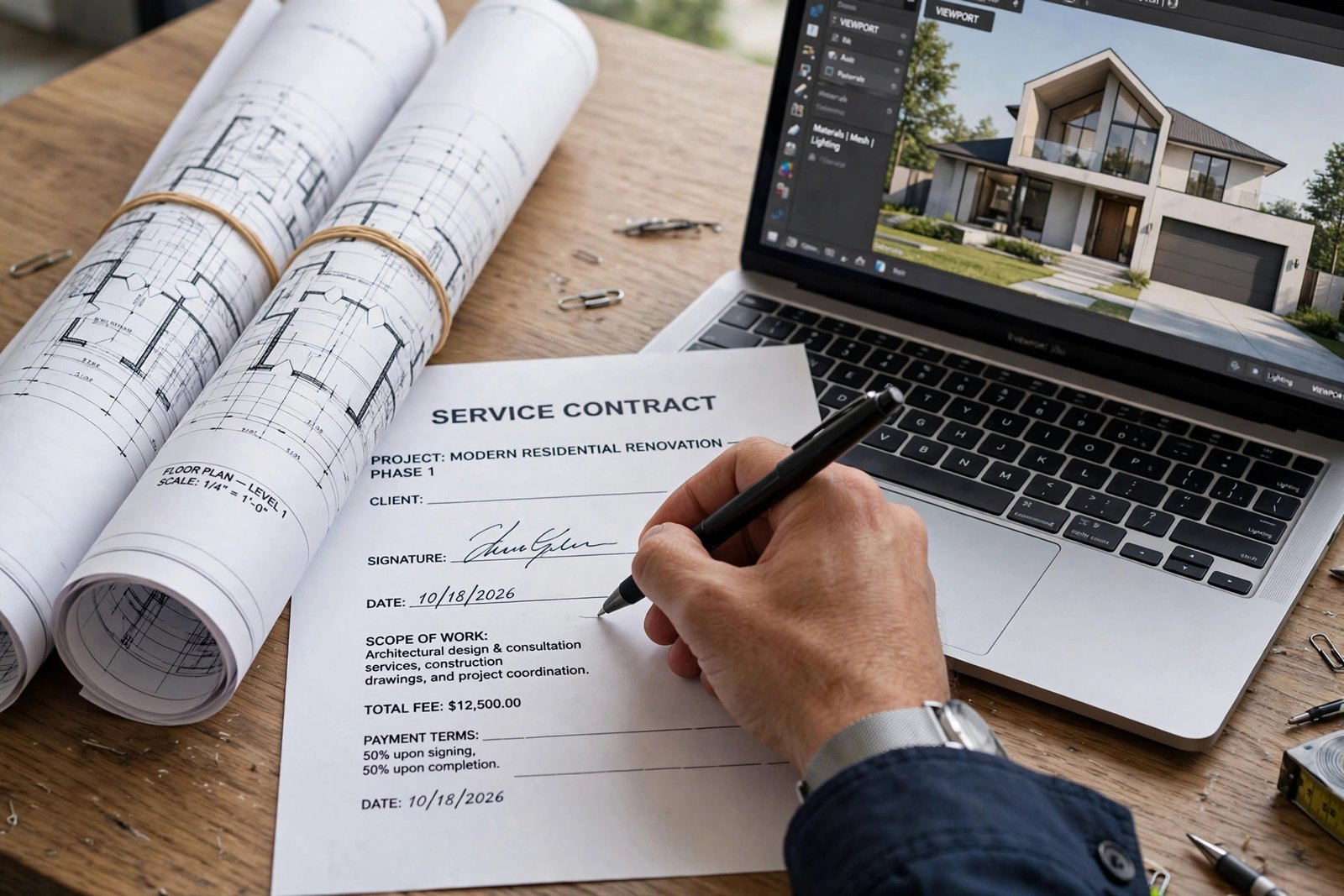
Even a simple one-page agreement should cover deliverables, timeline, revision policy, payment schedule, confidentiality, and image ownership. Usage rights deserve attention: most studios grant you full commercial use of final images, but confirm whether they retain the right to show the work in their portfolio, which is standard and reasonable.
11. Test With a Small Paid Pilot
If the project is large, commission a single test image first. A paid pilot reveals everything a portfolio cannot: how the studio interprets your brief, how they handle feedback, and whether they hit deadlines. The cost of one test render is trivial compared to the cost of discovering problems across a twenty-image package.
12. Trust Your Instincts on Red Flags
Walk away if you see these signs: no verifiable portfolio, pressure for full upfront payment, refusal to document the revision policy, consistently vague answers about timelines, or a quote far below every competitor. Also be cautious of studios that promise photorealistic results from AI tools alone with no real 3D process behind them. As we discuss in our article on AI in architectural design, AI assists the pipeline but cannot replace accurate 3D work.
Questions to Ask on the First Call
- Have you visualized this building type before? Can you show examples?
- What does your revision process look like, and what costs extra?
- What do you need from me to start, and what is your realistic timeline?
- Who will be my point of contact, and how do we handle feedback?
- What are the usage rights for the final images?
A studio that answers these clearly and directly is usually a studio that will deliver clearly and directly. For property developers specifically, it is also worth understanding how visuals fit the sales process, which our guide to VR and the future of real estate marketing touches on.
Frequently Asked Questions
Should I hire a freelancer or a studio?
Freelancers cost less and can be excellent for single images. Studios cost more but offer reliability, capacity for larger packages, structured revision processes, and backup if an artist is unavailable. For critical deadlines and multi-image campaigns, studios are the safer choice.
How much should I budget for visualization on a typical project?
For a residential project needing a handful of views, budget $1,500 to $4,000. Commercial developments with ten or more views typically run $8,000 to $25,000. Animations add $5,000 to $15,000 per minute of finished video.
Can a studio work from just 2D drawings?
Yes, most professional studios model from 2D plans, elevations, and sections. Expect modeling to add cost and a few days to the timeline compared to starting from your 3D model.
Who owns the final renders?
Typically you receive full commercial usage rights to the final images upon final payment, while the studio retains the 3D scene files and the right to display the work in its portfolio. Confirm this in writing, as terms vary.
How do I know if a portfolio is genuine?
Look for consistency in style and quality, project credits or client names, and case studies describing the process. Reverse image searching a few portfolio pieces can reveal stolen work. Studios that also share work-in-progress shots and breakdowns are almost always legitimate.
What if my design changes mid-project?
Minor tweaks fall under revisions. Significant design changes, like a new facade or altered massing, usually count as additional work and will be quoted separately. Lock your design before rendering starts to keep costs predictable.
Written by
Architecture Designing
3D Visualization Studio