Case Study: Azure Resort Maldives Visualization
The Stakes
The Azure Resort was one of the most ambitious visualization projects we've ever undertaken: 48 overwater villas, a central infinity pool complex, an underwater restaurant, and a private island, all requiring renders convincing enough to secure $120 million in pre-launch investment from institutional backers who would never set foot on the unbuilt site.
Institutional investors are a different audience from homebuyers. They do not fall in love with kitchens; they underwrite risk. Every image had to answer their unspoken question: is this real enough to bet nine figures on?
Two Tracks: Grandeur and Intimacy
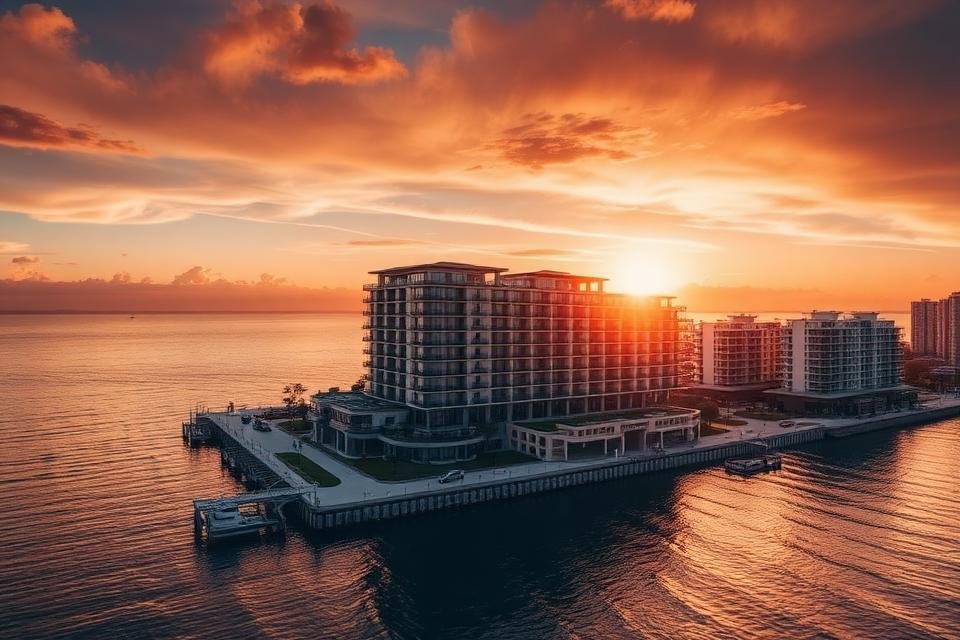
The project demanded two things simultaneously: sweeping grandeur (to convey scale and ambition) and intimate detail (to convey luxury and craftsmanship). We solved this by creating two parallel visualization tracks: drone-style aerial renders showing the entire development in its turquoise lagoon context, and close-up interior renders capturing the texture of every woven rattan chair and hand-carved coral detail.
The aerials established the investment thesis: location, scale, and the sheer improbability of the setting. The interiors established the revenue thesis: nightly rates are justified by tangible, photographable luxury.
Technical Deep Dive: Water, Light, Life
The underwater restaurant posed unique technical challenges. Simulating the caustic light patterns of shallow tropical water, the visual distortion through glass walls, and the presence of marine life required custom shader development. The result, warm afternoon light filtering through water to illuminate a candlelit dining room surrounded by reef fish, became the project's signature image.
Other technical hurdles included:
- Ocean surfaces that read correctly from both aerial distance and underwater proximity, requiring multi-scale wave simulation.
- Vegetation across a private island: thousands of instanced palms with wind animation for the film sequences.
- Atmosphere: tropical haze and humidity affect how far the eye sees; we matched real Maldivian atmospheric conditions rather than defaulting to crystal-clear CGI air.
- Human scale: carefully placed figures in key renders so investors could feel the scale of spaces instantly.
The VR Investor Experience
For the investor presentation, we built a full VR experience using Unreal Engine 5. Investors could "fly" over the island, dive into the underwater restaurant, and walk through villa interiors, all in real time. The spatial audio team added ocean waves, tropical birds, and the gentle splash of infinity pool edges.
Crucially, we designed the experience for first-time VR users in their fifties and sixties: seated, guided, no complex controls, each segment under three minutes. Technology serves the audience, not the other way around.
The Presentation
The presentation was held in Dubai's Burj Al Arab. Twelve investors donned headsets. Within two hours, $80 million in commitments were secured. The remaining $40 million closed within the week. The resort's developer later attributed the speed of the raise directly to the quality of the visualization.
Consider the alternative: raising $120M on architectural drawings alone would have taken months of due diligence trips, physical models, and slower conviction. Visualization compressed the trust-building timeline from quarters to days.
The ROI Math
The visualization budget was a rounding error against the raise, well under one percent of committed capital. But the real return was speed: every month of delayed financing on a project this size carries enormous holding costs. By accelerating commitments by months, the visualization work paid for itself many times over before a single foundation was poured.
Lessons for Institutional-Grade Visualization
- Know your audience's risk lens. Investors need conviction, not just beauty.
- Pair the epic with the intimate. Scale impresses; detail convinces.
- Design VR for the actual users, including their age and tech comfort.
- Invest in the signature image. One unforgettable render can carry a $120M conversation.
- Track the business outcome, not just the likes. Our portfolio measures projects in capital raised and units sold.
Azure taught us that at the institutional investment level, visualization isn't a marketing expense, it's a financial instrument. The quality of the renders directly correlates to the speed and size of capital commitment. In this case, our work didn't just depict a resort, it built one.
Further Reading
If you found this article helpful, you may also enjoy:
Frequently Asked Questions
How long did the Azure visualization take?
Fourteen weeks from brief to the Dubai presentation, with a dedicated team of nine artists and two VR developers.
What was the hardest technical challenge?
The underwater restaurant: convincing caustics, glass distortion, and marine life in one coherent image required custom shaders and weeks of iteration.
Can smaller developers get similar results?
The principles scale down perfectly. Even a single signature image plus a web-based 360 tour can transform an investor meeting at a fraction of this budget.
Team and Timeline
The Azure team peaked at eleven people: an art director, three environment artists, two interior specialists, a water and effects TD, two VR developers, a spatial audio designer, and a producer holding the schedule together. Fourteen weeks sounds generous until you itemize it: three weeks of look development, six weeks of production, three weeks of VR build and testing, and two weeks of buffer that we needed in full.
The producer's most important decision was sequencing: hero stills first (they anchored the whole campaign), VR second, film sequences last. When the inevitable crunch came, the assets that mattered most were already done.
From Renders to Reality
Eighteen months after the presentation, construction photos started arriving, and the team gathered to compare them against our renders. The match was uncanny: the underwater restaurant's caustic patterns, the villas' rooflines against the lagoon, even the planting palette. That comparison became one of our proudest portfolio pieces, because it proves the central claim of visualization: we do not invent fantasy, we preview reality.
For the developer, the renders kept working long after the raise, anchoring the resort's brand through construction and into its opening marketing. Great visualization is an asset with a multi-year half-life.
Written by
Omar Al-Farsi
Project Director