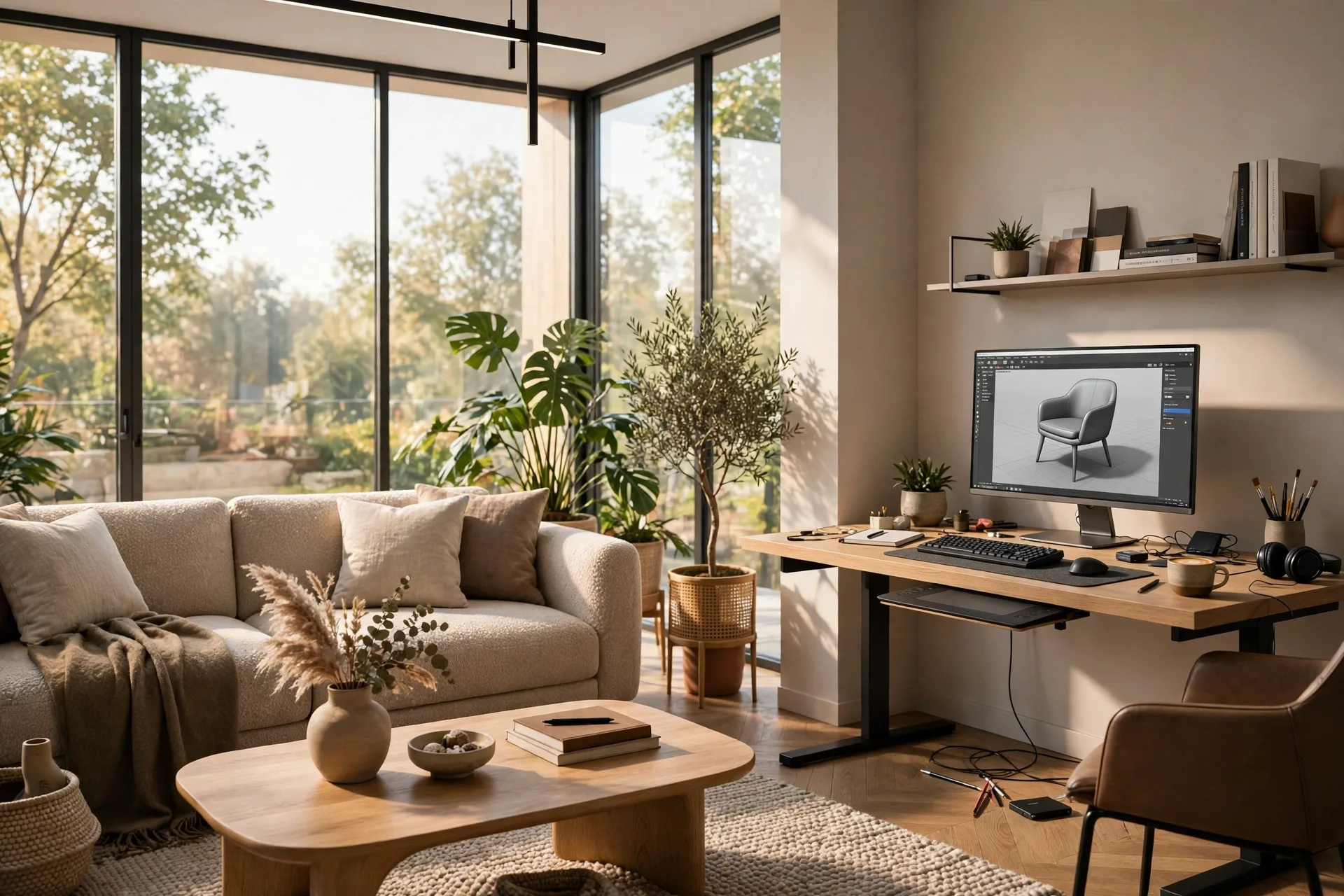
AI Rendering vs Human Artist: Honest 2026 Comparison
Type a prompt, wait thirty seconds, and a beautiful house exterior appears on your screen. AI image tools have improved so fast that many architects, developers, and homeowners now ask a fair question: do we still need a human 3D artist? The honest answer in 2026 is that AI rendering is a powerful new tool, but it is not a replacement for a professional artist. It is fast, cheap, and surprisingly good at first impressions, yet it still fails at the details that decide whether a render wins a client, passes a planning committee, or sells a home off plan. This guide compares both honestly, so you can choose the right tool for each job.
What AI Rendering Does Well in 2026
Modern AI image tools such as Midjourney, DALL-E 3, Stable Diffusion with ControlNet, Krea, and LookX can produce attractive architecture images in seconds. Give the tool a good prompt and it returns a convincing villa, interior, or dusk exterior. For early concept work this speed is genuinely useful: an architect can test ten facade ideas in an afternoon before committing to a design.
AI is also cheap at the point of use. Most tools cost 10 to 60 dollars a month for a subscription, and each image costs only a few cents to a few dollars to generate. There is no modelling time, no render farm bill, and no waiting days for a first draft. Our best rendering software guide covers the traditional tools AI now sits alongside, and many artists use both in the same project.
- Concept speed: dozens of design directions explored in a single afternoon.
- Low cost per image: cents per generation instead of hundreds of dollars per view.
- Style exploration: quick tests of materials, moods, and lighting directions.
Where AI Renders Still Fail
The problems start when an image has to be accurate. AI tools do not understand architecture; they predict what pixels usually look like. That means window counts change between views, doors appear in the wrong place, rooflines do not match the plans, and staircases lead nowhere. A human looking closely will find warped furniture, impossible reflections, garbled text on signs, and people with the wrong number of fingers. At thumbnail size these flaws hide well, but at full size on a brochure or a planning submission, they are obvious and they damage trust.
The deeper problem is consistency. A development launch needs the same house shown from the street, the garden, and the living room, with the same materials, the same facade, and the same proportions in every view. AI cannot hold that consistency. Each generation is a fresh guess, so the brick, the window frames, and the roof all change from one image to the next. A human artist works from one 3D model, so every view of the same building is the same building, and that accuracy is not a luxury, it is the entire point of a professional render.
What a Human Artist Brings That AI Cannot
A professional 3D artist does far more than make a pretty picture. The work starts with reading drawings, checking dimensions, and building an accurate 3D model of the real design. Materials are specified, not guessed: the exact brick, the real timber finish, the specified glass. Lighting follows the real sun path for the site and the season, and cameras are set at heights and focal lengths that match how a person would actually see the building. Our guide to realistic renders explains the twelve techniques professionals rely on.
The human advantage is also about judgement and accountability. An artist asks what the image is for, who will see it, and what decision it must support, then composes the view to answer those questions. If a client asks to change the facade material, move a camera, or show the garden in summer instead of winter, the artist changes the model and re-renders, with every other view staying consistent. AI cannot answer for its work, take a revision instruction, or guarantee that the image matches the approved drawings. That accountability is what clients are actually paying for.
Cost Comparison in 2026
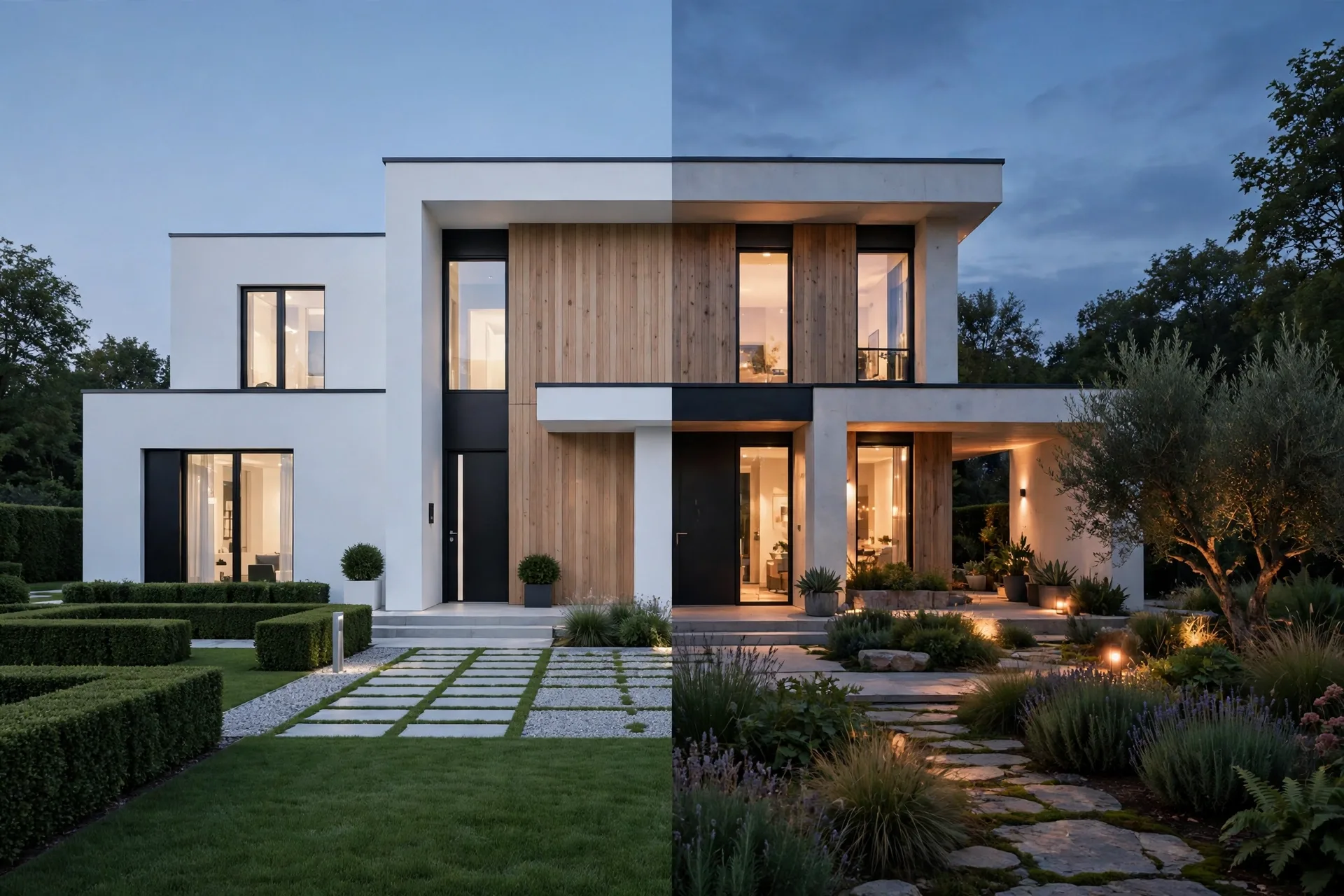
On a per-image basis, AI looks almost free and a human artist looks expensive. A professional interior view costs 200 to 800 dollars in 2026, an exterior view costs 300 to 1,500 dollars, and a full launch package can run to several thousand dollars. Our 3D rendering cost guide gives the full breakdown by render type. Against that, an AI subscription and a few dozen generations might cost less than 100 dollars in total, which makes AI look like the obvious choice until the hidden costs appear.
The hidden cost of AI is time. Generating one good image often takes twenty or thirty attempts, and fixing a warped window in Photoshop can take longer than modelling it properly. And an image that cannot be used costs the whole project: a delayed launch or a buyer who loses confidence. A human render costs more per view, but it arrives accurate, consistent, and ready to publish, with revision rounds included in the price.
Speed and Turnaround
AI wins on raw speed. A first image appears in under a minute, and a batch of concepts can be ready the same afternoon. A human artist needs three to seven working days for a single still view from a complete brief, and two to four weeks for a full package, as our rendering turnaround guide explains. If the deadline is a same-day design meeting or a social media post, AI is the right tool. If the deadline is a brochure print date, a planning submission, or a sales launch, the slower human route is the one that actually meets the deadline, because it does not need to be redone.
When to Use AI, and When to Hire a Human
The smartest studios in 2026 do not pick one side. The dividing line is simple: use AI when the image is disposable, and hire a human when the image must be right.
- Use AI for: early concept exploration, mood boards, style tests, social media content, and internal design discussions.
- Use AI for: testing how a space might feel before the design is fixed, when no one will measure the image against drawings.
- Hire a human for: planning submissions, marketing brochures, sales galleries, investor presentations, and any image a buyer will rely on.
- Hire a human for: multi-view packages where every image must show the same building, and for animation and virtual tours.
- Hire a human for: projects where materials, dimensions, or site context must match reality exactly.
The Hybrid Workflow That Works Best
The best results in 2026 come from combining both. Many artists now start with AI mood images to agree the look with a client quickly, then build the accurate 3D model and produce final renders by hand, while AI helps with texture ideas and styling references. This hybrid workflow is faster than pure human work and far more reliable than pure AI work.
- Concept with AI: generate mood images and style directions to agree the visual direction with the client in a day.
- Model with a human: build the accurate 3D model from CAD files, with specified materials and real dimensions.
- Light and compose by hand: set cameras, sun position, and interior lighting like a photographer, not a prompt.
- Render and refine: produce test renders, review against the brief, and revise in controlled rounds.
- Finish with care: use post-production for colour, contrast, and skies, and check every view against the model before delivery.
Studios that work this way deliver faster than studios that ignore AI, and they deliver work AI alone cannot match. The artist stays in charge of accuracy while AI handles the parts where speed matters most.
Frequently Asked Questions
Can AI replace a 3D rendering studio in 2026?
Not for professional work. AI is excellent for concepts and mood boards, but it cannot produce accurate, consistent packages that match real drawings. Studios use AI inside their workflow, not as a replacement for artists.
How much does AI rendering cost compared to a human artist?
AI tools cost 10 to 60 dollars a month, but reaching a usable image can take many attempts and hours of fixing. A human interior costs 200 to 800 dollars and an exterior 300 to 1,500 dollars in 2026, delivered accurate and ready to publish.
Can AI renders be used for planning permission?
Usually no. Planning officers need accurate verified views that match the submitted drawings. AI images cannot guarantee that accuracy, so committees expect professionally produced verified views.
Why do AI renders look wrong on close inspection?
AI predicts pixels rather than understanding buildings, so it invents details: wrong window counts, warped furniture, and garbled text. These flaws hide at thumbnail size but show at full size in print.
Will AI get good enough to replace artists soon?
AI will keep improving and take over more routine work, but the need for accuracy, consistency, and accountability will not disappear. The likely future is hybrid: artists use AI to work faster while keeping control of the final image.
Can a studio use AI and still deliver photoreal quality?
Yes, when AI is used for concept and reference while the final image is built from an accurate 3D model by a human artist. The quality comes from modelling, lighting, materials, and camera discipline, and those still need a professional.
AI rendering has changed architectural visualization for good, and any studio that ignores it will work slower than its competitors. But the change is in the workflow, not in what clients need: an accurate, beautiful image they can trust. AI gives you a fast first impression, a human artist gives you a final image that survives close inspection, matches the drawings, and sells the project. Use AI early and hire a professional for the images that matter. If you have a project where the renders need to be right, contact our studio with your drawings and we will give you a fixed quote and a clear timeline.
Written by
Architecture Designing Team
3D Visualization Studio