The Rise of Sustainable Architecture: Trends Shaping 2025
Sustainability Becomes the Organizing Principle
Sustainability has evolved from a buzzword to the central organizing principle of contemporary architecture. In 2025, the question is no longer whether a building should be sustainable, but how aggressively it can push the boundaries of environmental performance while remaining aesthetically compelling.
Regulation is accelerating the shift. Jurisdictions across Europe, North America, and Asia are tightening energy codes and, increasingly, embodied-carbon limits. What was once a marketing differentiator is becoming a legal baseline, and the architects who mastered sustainable design early now hold a decisive competitive advantage.
Living Facades Go Mainstream
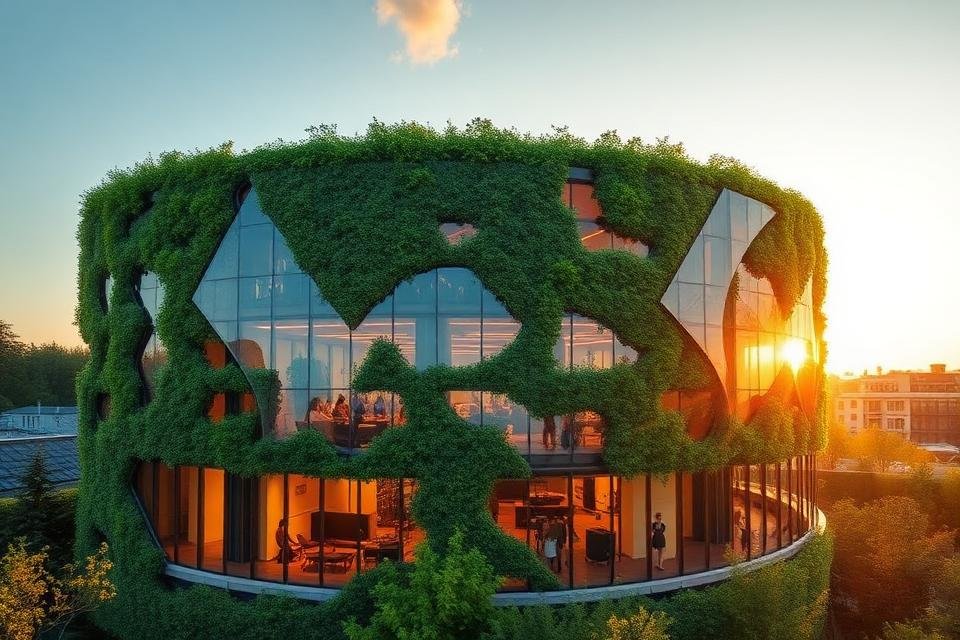
Living facades, vertical gardens integrated into building envelopes, have moved from experimental curiosity to mainstream practice. These bio-responsive surfaces don't just look striking; they actively filter air pollutants, reduce urban heat island effects, and provide habitat for local wildlife. Our recent Crystal Gardens project in Singapore demonstrated that a well-designed living facade can reduce a building's cooling load by up to 30%.
The engineering behind them has matured. Automated irrigation, integrated drainage, and plant palettes selected for local climate have turned living walls from maintenance nightmares into reliable building systems. For visualization, they demand botanical accuracy: generic green blobs no longer convince anyone, and the best renders now use species-correct planting models.
Net-Zero Energy at Commercial Scale
Net-zero energy buildings are also becoming commercially viable at scale. Advances in building-integrated photovoltaics (BIPV) mean solar panels can now be embedded directly into glass curtain walls without compromising transparency. Combined with geothermal heat pumps and AI-driven energy management systems, buildings can now generate more energy than they consume.
The economics have flipped. Falling renewable costs plus rising energy prices mean net-zero commercial buildings increasingly pencil out on pure financial terms, before any green premium is considered. Developers now ask for energy modeling as early as concept stage, and visualization that communicates energy features, solar shading, ventilation strategies, has become a standard part of the pitch.
The Materials Revolution
The materials revolution is equally transformative. Mass timber construction, once limited to low-rise structures, is now reaching 20+ stories. Cross-laminated timber (CLT) offers the structural performance of steel with a fraction of the embodied carbon. Meanwhile, self-healing concrete and carbon-capture cement are moving from laboratory to job site.
Embodied carbon, the emissions locked into materials and construction, is the industry's newest obsession. Lifecycle assessment (LCA) tools are being integrated into BIM workflows, letting architects compare the carbon cost of design options in real time. Expect "carbon budgets" to sit alongside financial budgets on serious projects within a few years.
Passive Design: The Quiet Powerhouse
Behind the headline technologies, passive design remains the highest-ROI sustainability strategy: orient the building correctly, shade it intelligently, ventilate it naturally, and insulate it well. These decisions cost almost nothing at concept stage and pay dividends for the building's entire life. The most sustainable kilowatt-hour is the one never needed.
Certifications Clients Ask For
- LEED: Still the global default for commercial projects, now with sharper embodied-carbon credits.
- BREEAM: Dominant in the UK and strong across Europe, with rigorous lifecycle criteria.
- WELL: Focuses on occupant health, increasingly paired with LEED on premium developments.
- Passive House: The gold standard for ultra-low operational energy, spreading from housing into larger typologies.
What This Means for Visualization
For visualization studios like ours, these trends present both challenges and opportunities. Rendering a living facade requires botanical accuracy; showing net-zero features demands technical storytelling. But the visual drama of sustainable architecture, the interplay of nature and geometry, light and green, makes for some of the most compelling imagery we've ever produced.
Practical advice: learn to visualize systems, not just surfaces. A cutaway showing airflow, a dusk render with BIPV glass glowing, a seasonal series showing a green facade maturing, these images sell sustainable design because they make invisible performance visible.
The Road Ahead
The future belongs to buildings that don't just shelter us, but actively heal the environments they inhabit. And the architects who embrace this truth will define the skylines of the next century. For the rest of us, our job is to make that future so vivid that clients cannot help but build it.
Further Reading
If you found this article helpful, you may also enjoy:
Frequently Asked Questions
Is sustainable design more expensive?
Upfront costs can be 2-5% higher, but operational savings typically pay this back within years. Passive strategies cost almost nothing and deliver the largest gains.
What is embodied carbon and why does it matter?
Embodied carbon is the emissions from manufacturing, transporting, and assembling building materials. As operational energy gets cleaner, embodied carbon becomes the dominant share of a building's footprint.
How do green certifications affect property value?
Certified buildings consistently command rent and sale premiums, lease faster, and show lower vacancy. The market has learned to price sustainability.
Retrofitting: The Greenest Building Is the One Already Built
New construction gets the headlines, but most of the building stock that will exist in 2050 is already standing. Deep energy retrofits, recladding, systems upgrades, and adaptive reuse now represent one of the largest architectural markets in developed economies. Designing a retrofit is harder than designing new: every decision negotiates with existing structure, and the constraints breed creativity.
For visualization, retrofits offer a compelling narrative arc: before-and-after sequences, phased construction visualizations, and energy-performance comparisons that make abstract savings tangible. Clients deciding whether to retrofit or rebuild respond strongly to imagery that shows both paths honestly.
Designing for Disassembly
The next frontier is circular construction: buildings designed so their components can be recovered and reused. Bolted rather than welded connections, material passports documenting every element, and modular layouts that adapt to new uses. Pioneering projects already demonstrate that a building can be a material bank for its successor. For architects, this adds a new design dimension: every detail must answer not only "how is it built?" but "how is it unbuilt?" Visualization can lead here too, with exploded axonometrics and lifecycle stories that make circularity legible to clients.
Written by
Elena Vasquez
Creative Director